
The terms “chatbot” and “virtual assistant” get used interchangeably all the time, but they describe two meaningfully different kinds of tools. One is purpose-built to handle a narrow set of conversations. The other is designed to act across your entire digital environment. Choosing the wrong one for your workflow doesn’t just waste budget—it creates friction where you were hoping to save time.
This comparison breaks down how chatbots and virtual assistants actually differ at a technical and practical level, where each one performs best, and how to decide which belongs in your stack. Whether you’re evaluating tools for a customer-facing business workflow or looking to streamline your own productivity, the distinction matters more than most people realize.
Chatbot Vs Virtual Assistant
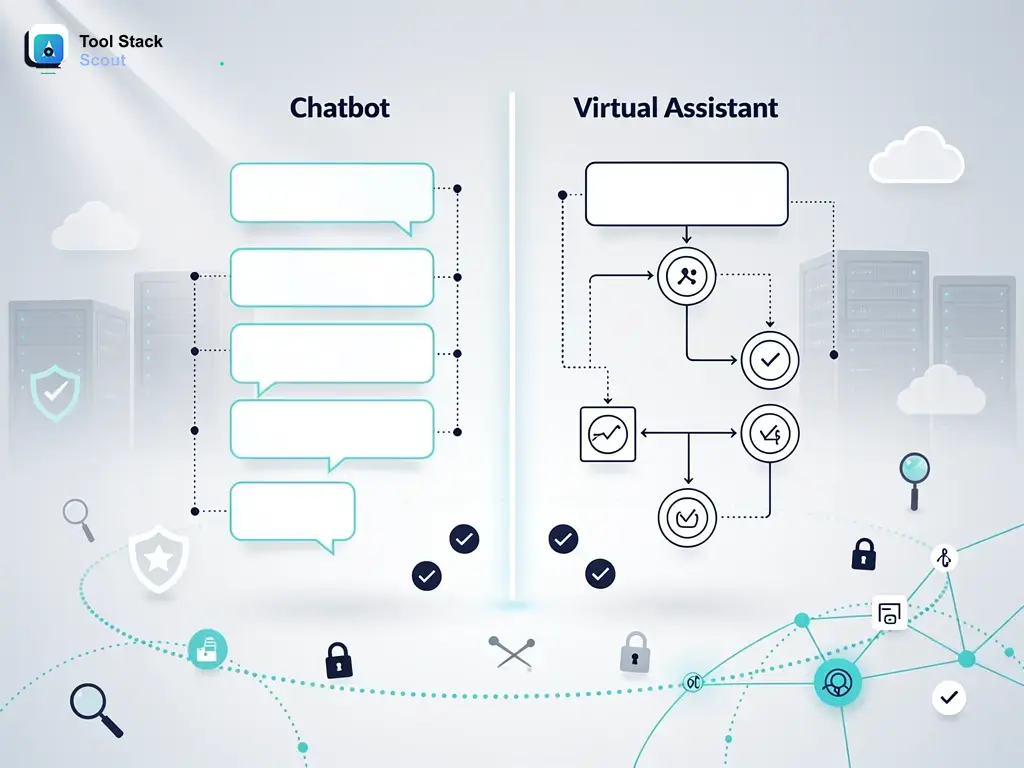
Chatbots are purpose-built tools designed to handle specific, rule-based conversation flows—think FAQ bots, order-status queries, or lead capture forms. Virtual assistants are broader AI-powered systems that understand context, manage tasks across multiple applications, and adapt over time. If you need scalable customer interaction at low cost, a chatbot delivers. If you need an adaptive layer that spans scheduling, messaging, device control, and more, a virtual assistant is the right fit.
Defining the Two Tools
Before comparing them side by side, it helps to anchor each term clearly. The industry does not always use these consistently, which is part of why the confusion persists.
What Is a Chatbot?
A chatbot is a software program designed to simulate conversation with human users, typically within a single channel or interface—a website widget, a messaging app, or a customer support platform. Most chatbots operate within a defined decision tree or set of trained intents. They recognize keywords or phrases and route users toward pre-written responses or workflows.
Rule-based chatbots follow strict if-then logic: if a user asks about shipping, the bot retrieves the shipping policy. More advanced chatbots use natural language processing (NLP) and machine learning (ML) to interpret phrasing more flexibly, but they still operate within a relatively contained scope. Their strength is consistency and scalability within that scope. A well-configured chatbot can handle thousands of identical queries per hour without fatigue or variation.
What Is a Virtual Assistant?
A virtual assistant is a broader AI-driven system built to manage tasks across multiple domains and platforms. Think of products like Amazon Alexa, Apple Siri, Google Assistant, or enterprise AI tools that connect to your calendar, email, project management suite, smart devices, and communication apps simultaneously. Virtual assistants are designed to understand conversational context across a session, remember preferences, and execute multi-step tasks that span different systems.
The technology underneath a virtual assistant typically includes more sophisticated NLP, intent recognition across diverse task types, integration APIs, and in many modern cases, large language model (LLM) capabilities that allow for open-ended reasoning. A virtual assistant doesn’t just answer questions—it takes action: scheduling a meeting, sending a message, summarizing a document, adjusting smart home settings, or drafting an email response.
How They Compare: Technology and Capabilities
The Technology Behind Each
At the core of most modern chatbots is a combination of NLP for intent classification and entity extraction, paired with a dialogue management layer that controls conversation flow. Rule-based systems rely on decision trees. ML-powered chatbots are trained on labeled datasets of past conversations and can generalize to new phrasings of the same intent. The training scope is narrow by design—this makes the bot faster and more predictable within its domain, but brittle outside it.
Virtual assistants operate on a fundamentally different architecture. They need to handle ambiguous, multi-step requests that cross domain boundaries: “Move my 3pm meeting to Thursday and send the team a message about it” requires calendar access, contact data, and a messaging integration—all coordinated in a single response. Modern virtual assistants increasingly rely on large language models for reasoning and generation, layered on top of tool-calling APIs that execute real actions in connected applications.
Scope of Capability
A chatbot is good at what it was trained for and unreliable outside that boundary. If a user asks a customer support chatbot about a topic it wasn’t trained on, the experience degrades quickly—either producing an unhelpful fallback response or misrouting the conversation entirely. This isn’t a flaw so much as a design constraint: chatbots trade breadth for depth and consistency.
Virtual assistants are built for breadth. The trade-off is that they’re harder to deploy, require significantly more integration work, and introduce more surface area for things to go wrong. They can also raise more substantive privacy considerations, since performing their core function often requires persistent access to email, calendar, messages, and browsing history. If you want an assistant that feels proactive and context-aware, that capability comes at the cost of data access and setup complexity.
| Criteria | Chatbot | Virtual Assistant | Quick verdict |
|---|---|---|---|
| Best for | Customer support teams, e-commerce sites, lead generation workflows, and FAQ automation at scale | Professionals managing schedules and communications, smart home users, and teams using AI-augmented productivity tools | Use a chatbot for high-volume, focused customer interactions; use a virtual assistant for personal or team productivity across multiple systems |
| Core use case | Answering FAQs, processing orders, qualifying leads, handling tier-1 support tickets inside a single channel | Scheduling meetings, setting reminders, controlling smart devices, summarizing emails, drafting responses, and executing multi-step tasks | Chatbots excel at structured, transactional tasks; virtual assistants handle open-ended, cross-app workflows |
| Strengths | Fast to deploy, cost-effective at scale, delivers consistent responses, integrates cleanly into websites and messaging platforms | Context-aware across a session, handles diverse task types, integrates across platforms and devices, adapts to user preferences over time | Chatbots win on simplicity and cost-efficiency; virtual assistants win on flexibility and functional depth |
| Limitations | Struggles with ambiguous or out-of-scope queries, limited to predefined flows, degrades quickly at the edges of its training data | Higher setup and integration complexity, requires broad data access, can raise privacy concerns, more points of failure across connected systems | Verify data privacy policies and integration requirements before committing to either tool in a business context |
| Best decision rule | When you need a scalable, low-maintenance tool to handle predictable, high-volume interactions within a defined topic area | When you need an adaptive AI layer that spans multiple tools, devices, task types, and requires ongoing contextual reasoning | Match the tool’s scope to your actual workflow complexity—don’t over-engineer with a virtual assistant where a chatbot will do |
Pros and Cons
Knowing the advantages and limitations of each tool in concrete terms makes the selection decision far more straightforward. The comparison below focuses on real workflow implications rather than feature lists.
Advantages of Chatbots
Chatbots are among the most cost-efficient ways to handle customer-facing communication at scale. Once configured and trained, they require relatively little ongoing maintenance compared to a virtual assistant setup, and they deliver consistent, auditable responses. For businesses running high volumes of repetitive inquiries—order tracking, account FAQs, appointment scheduling—a chatbot reduces support costs while maintaining a reasonable user experience.
They’re also significantly easier to deploy in a single-channel context. Adding a chatbot to a website, WhatsApp line, or Slack workspace is a well-understood integration pattern with mature tooling available. The feedback loop for improvement is tight: you can monitor unhandled intents, retrain on new examples, and measure resolution rates with precision.
Limitations of Chatbots
The same narrowness that makes chatbots reliable makes them frustrating when a user steps outside the trained scope. A customer who phrases their question in an unexpected way, or who has a problem that wasn’t anticipated during training, will likely hit a dead end. Without a clear escalation path to a human agent or a more capable system, this can damage the customer experience badly enough to outweigh the efficiency gains.
Chatbots also struggle with multi-turn conversations that require remembering context from earlier in the session, especially in rule-based implementations. They are transactional by nature, not relational—a limitation that matters more as users expect increasingly fluid, natural interactions from AI tools.
Advantages of Virtual Assistants
The defining advantage of a virtual assistant is its ability to act, not just respond. Where a chatbot surfaces information, a virtual assistant executes tasks—booking the flight, sending the email, updating the calendar entry. This transforms the interaction from a look-up into a genuine delegation, which is where significant time savings actually accumulate for individual users and teams.
Modern virtual assistants, particularly those built on large language models, have also dramatically improved at understanding conversational context, handling ambiguity, and reasoning through multi-step requests. If your workflow involves coordinating across several tools or requires the kind of judgment that doesn’t fit neatly into a decision tree, a virtual assistant is the appropriate category of tool.
Limitations of Virtual Assistants
Virtual assistants introduce more moving parts, and more moving parts means more ways for things to break. Integration failures, permission errors, and inconsistent behavior across connected apps are real operational risks. For business deployments especially, the setup cost—both in engineering time and in establishing appropriate data governance—can be substantial.
Privacy is also a genuine concern worth examining carefully rather than dismissing. A virtual assistant that genuinely helps with email, calendar, and communications necessarily has access to sensitive data. Reviewing what data is stored, how long it’s retained, and whether it’s used to train models should be a standard step before deploying any virtual assistant in a professional context.
Real-World Applications
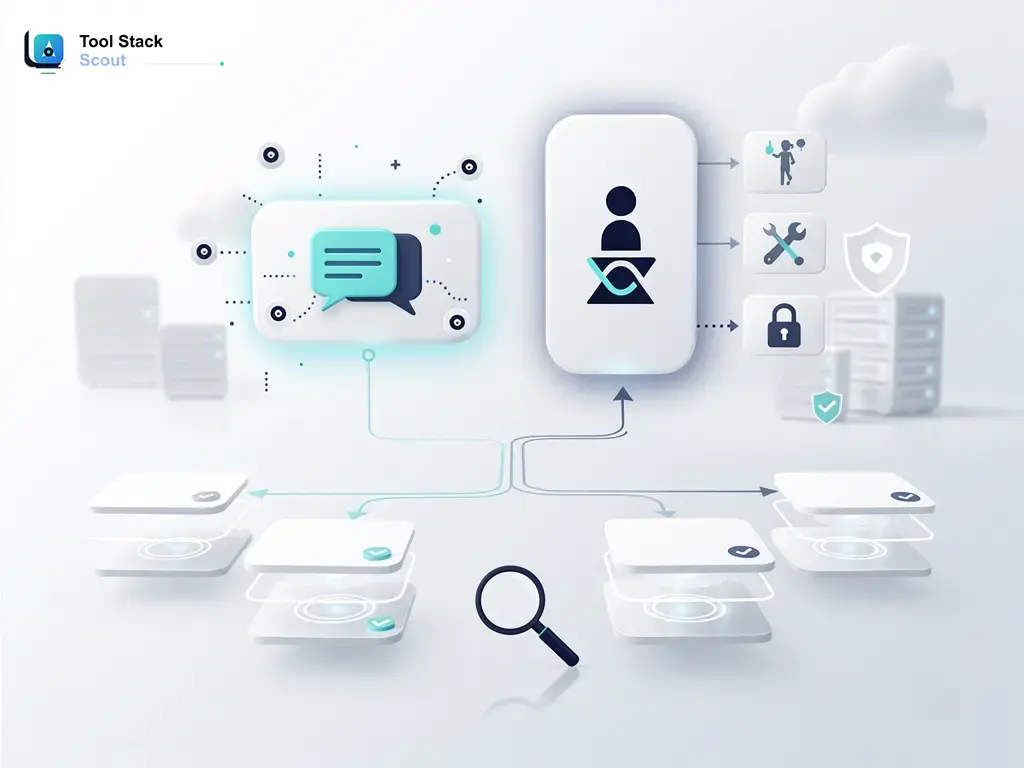
Theory aside, the clearest way to understand the difference is to look at where each tool actually shows up and what it’s doing there.
Chatbots in Business
The most established chatbot use case is customer support deflection—intercepting incoming support requests and resolving the straightforward ones before they reach a human agent. E-commerce companies use chatbots to handle order status queries, return initiations, and product questions at volume. Financial services firms deploy them for account balance inquiries, fraud alerts, and branch-finder flows. Healthcare organizations use them for appointment booking and triage screening.
On the marketing side, chatbots handle lead qualification on landing pages, guide users through product selection flows, and run promotional campaigns inside messaging apps. In internal operations, they serve as first-line IT helpdesk bots, HR FAQ tools, and onboarding assistants for new employees. In each of these cases, the chatbot’s value is anchored to a specific, bounded task where volume is high and the range of possible conversations is predictable enough to train for.
Virtual Assistants in Everyday and Professional Life
Consumer virtual assistants like Siri, Alexa, and Google Assistant have made voice-activated task management a household experience—setting timers, playing music, controlling smart home devices, answering general knowledge questions, and managing shopping lists. The interaction model is open-ended by design: users don’t need to know the right keywords, they just speak naturally and the system figures out the intent.
In professional settings, AI-powered virtual assistants are increasingly embedded in productivity suites. Tools that connect to your email, calendar, and communication platforms can draft replies, summarize meeting notes, surface relevant documents before a call, and flag overdue tasks. For teams using platforms like Microsoft 365 or Google Workspace, the AI assistant layer is becoming a standard part of the workflow rather than an add-on. For a deeper look at how specific virtual assistant platforms compare, the Gemini vs Google Assistant breakdown covers two of the most widely used options in detail.
Which One Should You Choose?
The clearest frame for this decision is scope. Ask yourself: is the task you want automated narrow and high-volume, or is it varied, context-dependent, and spread across multiple tools?
If you’re a business looking to reduce the cost of tier-1 customer support, handle FAQ traffic without scaling your human team, or run a lead qualification flow on your website, a chatbot is almost certainly the right tool. It’s faster to deploy, easier to maintain, and the ROI is measurable against a specific interaction volume.
If you’re an individual professional or a team that wants an AI layer capable of taking real action across your digital environment—managing your schedule, drafting communications, summarizing information from multiple sources, or controlling connected devices—a virtual assistant is what you’re describing. The investment in setup and data access is real, but so is the productivity return when the integration works well.
It’s also worth noting that the line between these two categories is blurring. Many enterprise chatbot platforms now incorporate LLM-based reasoning that gives them virtual-assistant-like flexibility within a defined domain. And many virtual assistants now offer structured, rule-based modes for specific high-volume tasks. For a broader view of the AI tools landscape, the AI Tools category on Tool Stack Scout covers the full range of options across both categories.
Conclusion
Chatbots and virtual assistants are not interchangeable, and treating them as such leads to mismatched tools and wasted investment. A chatbot is a focused, efficient system for handling predictable conversations at scale—ideal for customer-facing business workflows where volume is high and scope is contained. A virtual assistant is a broader, more capable system that acts across your digital environment, handling diverse task types and adapting to context over time.
The right choice depends on what you’re actually trying to automate. If the answer is a specific, repeatable conversation flow, start with a chatbot. If the answer is a flexible AI partner that can operate across your tools and reduce genuine cognitive load, look at virtual assistant options—and factor in the integration work and privacy considerations that come with them. Neither tool is universally superior; they solve different problems, and the best outcome comes from matching the tool to the actual job.