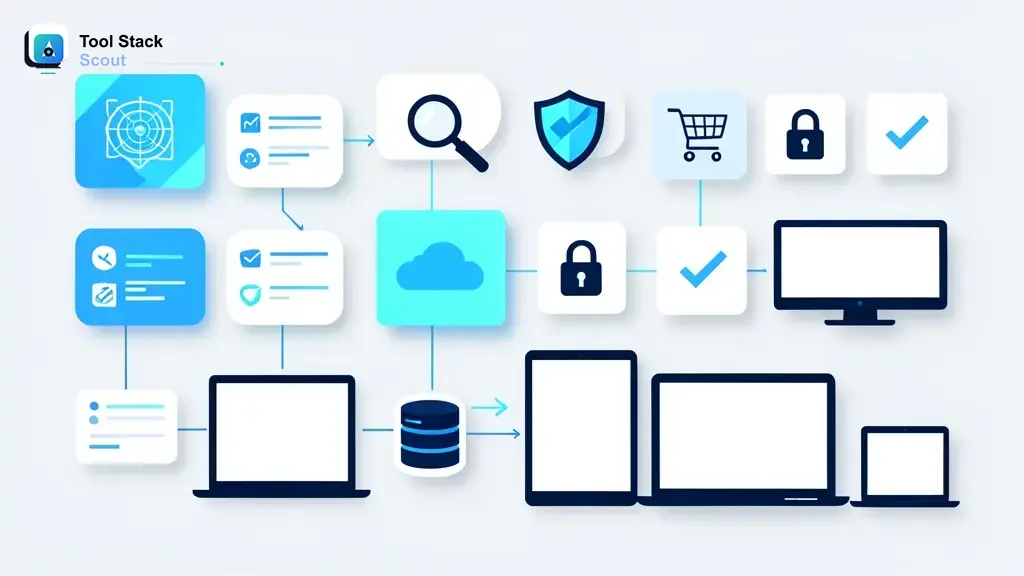
If you want quick, practical ai agents examples, start with this rule: an AI agent does more than reply. It observes, decides, and takes action toward a goal. That can be as simple as a thermostat adjusting room temperature or as advanced as a software agent that researches leads, drafts outreach, updates a CRM, and books meetings.
That matters because many tools get labeled “AI agent” when they are closer to chatbots or fixed automations. This guide bridges classic intelligent agent theory with modern software reality so you can spot what counts, what does not, and which examples match your workflow. For more AI tool coverage, browse Tool Stack Scout.
Ai Agents Examples
Best starting point: separate basic assistants from true agents by looking for goal-driven action, memory, tool use, and multi-step planning. This guide covers everyday devices, personal productivity tools, and business systems so readers can map examples to real work fast.
One useful way to read this page: start with textbook examples, then move to software examples. That keeps terms like simple reflex agent, goal-based agent, and utility-based agent grounded in familiar systems before you apply them to customer support bots, research agents, or scheduling tools.
Also note that not every “agent” is fully autonomous. Some products still need human approval before sending emails, changing records, or triggering workflows. That is not flaw. For many teams, partial autonomy is safer and easier to adopt than fully hands-off execution.
How to read these AI agent examples
This article is not ranking products from best to worst. It organizes examples by how agents work in practice: sensing, reasoning, planning, memory, tool use, and action. That makes it easier to compare thermostat, robot vacuum, and sales outreach agent without forcing them into same box.
If you want broader market view after this page, see our guide to best AI agents. If you are focused on home use, our breakdown of best virtual assistant for home automation is useful companion.
| Tool | Best for | Why it stands out | Main trade-off |
|---|---|---|---|
| ai agents examples | Readers comparing classic and modern agent use cases | Shows full spectrum from simple sensors to multi-step software systems | Broad topic, so individual tools still need separate evaluation |
| AI agent | Teams automating goal-driven digital tasks | Combines reasoning, tool use, and action instead of chat alone | Quality depends on permissions, prompts, and integration depth |
| intelligent agent | Students, researchers, and buyers learning core AI concepts | Useful umbrella term that links textbook theory to modern software | Term gets used loosely, which can blur real capability differences |
| autonomous system | Operations, robotics, and workflow-heavy environments | Highlights systems that can respond with limited human input | Higher autonomy can raise oversight and reliability concerns |
| reasoning | Research, support, and analysis workflows | Improves decisions when task needs context, judgment, or step-by-step logic | Can slow output or add cost versus simple scripted automation |
| planning | Multi-step business processes and task orchestration | Separates strong agents from one-turn assistants by mapping next actions | Plans still fail if tool access, data quality, or guardrails are weak |
What AI agent means in practice
An AI agent is system that perceives environment, makes decisions, and acts toward goal. In software, “environment” often means apps, documents, messages, databases, websites, or user instructions. In physical systems, it can mean sensors, cameras, switches, or movement in real space.
Three traits matter most:
- Observation: it takes in information, such as email inbox, room temperature, or customer request.
- Decision-making: it chooses what to do next based on rules, learned behavior, or reasoning.
- Action: it updates records, sends messages, changes settings, or triggers another step.
That is why plain chatbot is not always agent. Chatbot may answer questions well but still wait for every prompt. Agent can often carry state across steps, choose among tools, and push task forward.
AI agent vs chatbot vs workflow automation
Chatbot is conversation-first. Its main job is to respond to messages. Workflow automation is rule-first. Its main job is to follow fixed triggers like “when form submitted, send Slack alert.” AI agent sits between and beyond them: it can interpret messy inputs, decide among options, and complete multi-step goal.
Practical test: if you removed live user prompting, would system still make progress? If yes, you are likely looking at agent. If no, you are likely looking at chatbot or basic automation.
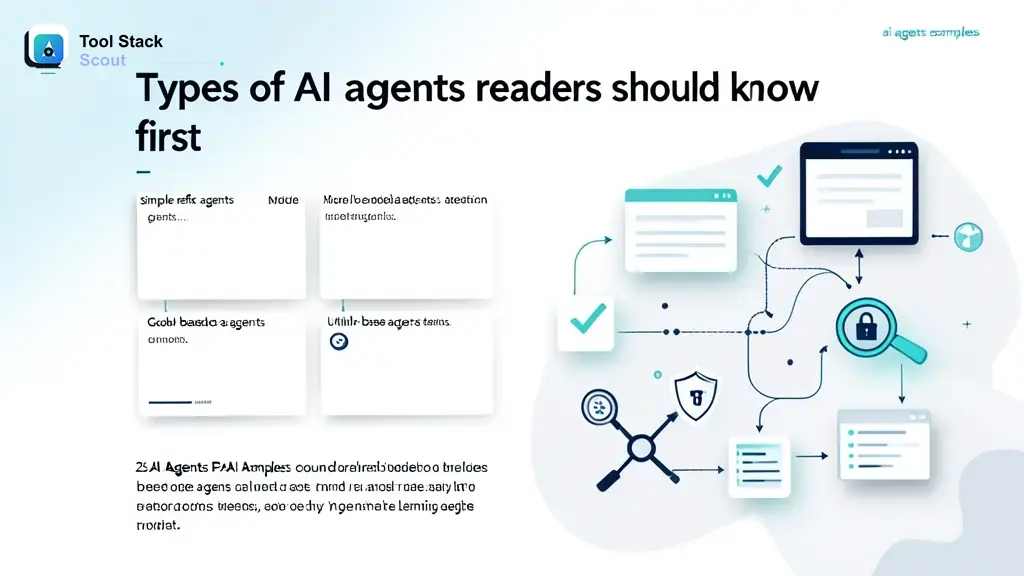
Types of AI agents readers should know first
Many examples of agents make more sense once you know five common categories. These appear in AI textbooks and still map well to modern products.
1. Simple reflex agents
These follow direct if-then rules. They do not build deep model of world. If room gets too cold, thermostat turns heat on. If motion appears near automatic door, door opens.
2. Model-based agents
These keep some internal state about environment. Robot vacuum is good agent example here. It does not only react to bump; it tracks obstacles, floor layout, or battery status to choose next move.
3. Goal-based agents
These evaluate actions based on target outcome. Navigation system trying to get you to destination is common intelligent agent example. It may recalculate route if traffic changes because goal stays same: arrive efficiently.
4. Utility-based agents
These weigh trade-offs, not only end goal. Ride pricing systems, recommendation engines, or ad bidding tools may balance speed, cost, conversion probability, and user satisfaction instead of optimizing one metric alone.
5. Learning agents
These improve over time from feedback or new data. Spam filters, recommendation systems, and support routing agents often fit here. They change behavior as they see more examples and outcomes.
Takeaway: if you want simple, predictable behavior, reflex or rule-heavy agents often fit best. If you want adaptation, prioritization, or changing plans, look for model-based, utility-based, or learning systems.
25 AI agents examples from everyday life to business software
Below are 25 examples grouped from simple to advanced. That mix reflects real search intent: some readers want textbook intelligent agents examples, others want software they can use at work now.
Simple intelligent agent examples from everyday life
- Smart thermostat: senses temperature, compares against target, adjusts heating or cooling.
- Automatic door sensor: detects motion and opens or closes based on immediate condition.
- Robot vacuum: avoids obstacles, tracks battery, and returns to dock when needed.
- Adaptive traffic signal: adjusts light timing based on traffic flow and congestion patterns.
- Spam filter: classifies incoming emails and routes them away from inbox.
- Fraud alert system on payment card: flags unusual transaction patterns for review or blocking.
- Smart irrigation controller: uses weather and soil conditions to decide watering schedule.
- Recommendation engine in streaming app: suggests content based on past behavior and predicted preference.
These examples matter because they show agent behavior without hype. Most people already use intelligent agents examples daily, even if they do not call them agents.
Modern AI agents examples for digital work
- Customer support agent: reads ticket, pulls account context, drafts reply, and may route or resolve issue.
- Sales outreach agent: researches prospect, writes outreach sequence, updates CRM, and suggests next follow-up.
- Scheduling and meeting agent: compares calendars, proposes times, sends invites, and manages reschedules.
- Research agent: gathers information across documents or web sources, summarizes, and organizes findings.
- Email triage agent: sorts inbox, drafts replies, flags urgent items, and schedules reminders.
- Document review agent: checks long files for key clauses, changes, or inconsistencies.
- Coding agent: reads codebase context, proposes changes, runs checks in supported setups, and explains output.
- Data analysis agent: cleans data, runs queries, builds charts, and suggests next questions.
- Knowledge base agent: answers from internal docs and can route unresolved requests to right team.
- Procurement agent: compares vendors, tracks approvals, and organizes purchase documentation.
Many of these overlap with tools discussed in our Manus AI agents coverage, where agentic workflows go beyond one-turn prompting and into task execution.
Examples of agents for personal use
- Travel planning agent: builds itinerary from dates, budget, interests, and logistics.
- Shopping assistant agent: compares products, watches for fit criteria, and narrows options.
- Study assistant agent: turns notes into quizzes, study plans, and concept explanations.
- Personal finance categorization agent: sorts transactions and flags unusual spending patterns.
- Home automation routine agent: coordinates lights, locks, climate, and presence triggers.
- Health habit coach: tracks routines, prompts next actions, and adapts reminders over time.
- Content repurposing agent: turns one source document into social posts, email copy, or outline variations.
Takeaway: for personal productivity, best agents save switching time across apps. For business use, best agents reduce repetitive work without losing oversight.
Everyday intelligent agent examples, explained
Some readers want one clear example rather than long list. Here are four that make concept easy to grasp.
Thermostat
This is classic simple reflex agent. It watches current temperature, compares it with desired range, and triggers heating or cooling. Limited memory, clear action, narrow goal.
Automatic door
This is even simpler. Motion near sensor becomes trigger. No planning, little context, but still qualifies as agent because it senses and acts in environment.
Robot vacuum
This is stronger intelligent agent example because it uses more than one signal: obstacles, edges, battery level, maybe room map. It adjusts path as environment changes.
Adaptive traffic system
This shows agent behavior at system scale. Instead of fixed timing, it reacts to live conditions and optimizes flow. Goal can be shorter waits, smoother movement, or emergency response priority.
Decision rule: if you are teaching or learning basics, start with thermostat and robot vacuum. If you are buying software, skip to digital workflow examples because those show planning and tool use better.
Modern AI agents examples for writing, coding, study, and long-document work
People searching for AI agents today often mean software that can complete knowledge work. Four workflows stand out because they show where agents help most and where limits still matter.
Writing workflows
Writing agent can take brief, gather supporting context, propose outline, draft sections, rewrite for tone, and prepare variants for email, blog, or social. Best fit: content teams, marketers, founders, and internal comms.
Main trade-off: writing agents can move fast, but they still need human review for accuracy, claims, and brand voice. They are strongest when task has structure, examples, and clear acceptance criteria.
Coding workflows
Coding agent can inspect repository context, suggest files to change, explain dependencies, draft tests, and surface likely issues. Best fit: developers handling repetitive bug fixes, refactors, scaffolding, or documentation.
Main trade-off: more autonomy increases need for review. Strong coding agents still depend on repository access, environment setup, and approval rules. For teams evaluating current platforms, our look at Droven.io AI automation tools helps frame how agentic automation differs from standard task runners.
Study workflows
Study agent can convert lecture notes into flashcards, summarize chapters, build quiz sets, and adapt explanations to skill level. Best fit: students, researchers, certification candidates, and knowledge workers learning new domain.
Main trade-off: study agents are great for compression and repetition, weaker for guaranteeing correctness in niche topics. Use them to structure learning, not replace source checking.
Long-document workflows
Document agent can search across contracts, reports, policies, transcripts, or manuals and answer questions with context from multiple sections. Best fit: legal ops, procurement, HR, compliance, and leadership teams dealing with dense files.
Main trade-off: document quality depends on retrieval setup, permissions, and chunking method. If source files are messy, answer quality often falls fast.
Takeaway: for writing and study, agent value comes from structure and speed. For coding and long documents, value comes from context handling and multi-step execution.
AI agents examples by industry
Industry use matters because same core agent can look very different across workflows. Here are strong examples by business function.
Healthcare
- Patient intake agent that collects symptoms and routes next step
- Appointment follow-up agent that manages reminders and reschedules
- Clinical documentation support agent that structures notes for review
Best fit when process is repetitive, high-volume, and still needs audit trail. Main caution: sensitive data, permissions, and review requirements usually matter more than raw automation speed.
Finance and accounting
- Invoice processing agent that extracts fields and flags mismatches
- Expense review agent that categorizes spend and detects anomalies
- Collections support agent that prioritizes outreach based on payment risk
Best fit when work involves structured documents and recurring exceptions. Main caution: false positives and approval logic can create extra cleanup if guardrails are weak.
Retail and ecommerce
- Product recommendation agent that adapts to browsing behavior
- Customer service agent that handles returns, order questions, and exchanges
- Inventory planning agent that suggests reorder timing based on demand patterns
Best fit when customer volume is high and decisions need speed. Main caution: over-automation can hurt customer trust if edge cases get trapped in loops.
HR and recruiting
- Candidate screening agent that organizes applications and surfaces matches
- Interview scheduling agent that coordinates calendars and reminders
- Employee help desk agent that answers policy and onboarding questions
Best fit when teams want faster admin work without growing headcount. Main caution: hiring and people workflows need careful review for bias, fairness, and escalation rules.
Decision rule: choose industry use cases where data is available, actions are repeatable, and success can be measured clearly in time saved, resolution rate, or accuracy improvement.
Examples of agents for personal use
For individuals, best agent examples are not always most autonomous ones. Best fit is usually narrow task, clear goal, and low risk if output needs correction.
Travel planning agent
Useful when trip has many moving parts: dates, budget, stops, and preferences. Strong version proposes itinerary and adapts when you reject part of plan.
Email management agent
Useful when inbox load is high. Strong version groups messages by urgency, drafts replies, and turns messages into tasks or calendar items.
Shopping assistant agent
Useful when product choice depends on multiple constraints, such as size, budget, feature set, or compatibility. Strong version narrows options instead of flooding you with results.
Study assistant agent
Useful when you need repetition and structure. Strong version tracks progress, changes quiz difficulty, and revisits weak topics.
Takeaway: for personal use, choose agent based on annoyance removed, not novelty. If it saves context switching every day, it is probably worth trying.
How to tell whether tool is true AI agent
Marketing language is loose, so use this checklist.
Signs of real AI agent
- Can pursue goal across more than one step
- Uses memory or persistent context
- Chooses among tools or actions
- Handles messy inputs, not only fixed forms
- Can trigger actions, not only generate text
- Adapts when first plan fails
Signs of basic automation dressed as agent
- Only runs fixed if-then sequence
- Cannot change plan or recover from errors
- Has no tool access beyond chat box
- Needs constant user prompting to continue
- Produces output but cannot execute anything
If you are exploring broader categories, AI Tools category is useful for comparing agent-adjacent software with assistants and automations.
How businesses pick right AI agent use case
Most teams should not start with highest-stakes workflow. Start where value is obvious and cleanup cost is low.
- Pick repetitive, high-volume task. Support triage, scheduling, document intake, and internal search are common first wins.
- Check data access. Agent is only as useful as tools and records it can reach safely.
- Define action boundaries. Decide what it can do alone and what needs approval.
- Measure one clear outcome. Time saved, response speed, resolution rate, or handoff reduction.
- Expand after trust builds. Move from assistive mode to semi-autonomous mode, then broader rollout.
Best first use case for small business is often support, scheduling, inbox triage, or lead qualification. These have clear inputs, frequent repetition, and easy before-and-after measurement.
Best first use case for technical teams is usually code assistance, document search, or internal ops automation because access patterns and review loops are already familiar.
Real decision rule: pick agent use case where failure is visible, recoverable, and cheap. Avoid fully autonomous workflows first if bad output can change records, charge customers, or create compliance problems.
FAQ about AI agents examples
What is one clear example of an AI agent?
Smart thermostat is one of clearest examples. It senses temperature, compares against goal, and acts by changing heating or cooling.
Is ChatGPT an AI agent?
By itself, not always. In plain chat mode, it is closer to conversational assistant. When connected to tools, memory, and multi-step task execution, it can function more like agent.
What are intelligent agents examples in AI textbooks?
Common textbook examples include thermostat, vacuum-cleaning robot, chess-playing program, self-driving system, spam filter, and route-planning software.
What are best AI agents examples for small business?
Best small-business examples are support agents, scheduling agents, inbox triage agents, lead qualification agents, and document-processing agents. They solve frequent tasks without requiring huge custom builds.
What is difference between AI agent and chatbot?
Chatbot mainly responds to prompts. AI agent can often keep context, make decisions, use tools, and take action toward goal.
Final verdict
If you only need answers, summaries, or one-off prompts, use assistant or chatbot. If you need system that can observe, decide, and act across steps, choose agent.
For beginners, best examples to understand are thermostat, robot vacuum, spam filter, and scheduling agent. For business buyers, best starting use cases are support triage, document handling, and internal research. For teams comparing live options, do not ask whether tool is “AI-powered.” Ask whether it can complete goal with memory, tool use, and controlled autonomy.
That is practical line between hype and value. If tool cannot move work forward on its own, it is not best thought of as agent. If it can, and you can measure result safely, that is where AI agents start becoming worth deploying.